> For the complete documentation index, see [llms.txt](https://help.citrusad.com/retail-media-interface/llms.txt). Markdown versions of documentation pages are available by appending `.md` to page URLs; this page is available as [Markdown](https://help.citrusad.com/retail-media-interface/partner/campaign-management-api/bannercampaign.md).
# Banner campaign
A banner campaign is an online advertising strategy that uses visual ads on websites or apps to promote products or brands. These ads capture attention and drive traffic. You can measure their effectiveness using metrics like click-through rates and conversions.
Banner ads effectively introduce a brand message and can boost both online and in-store sales. Epsilon Retail Media enhances ad relevance by using selected products and filters that match the page context. Advertisers can upload static JPEG or PNG creatives, choose a banner slot, and associate relevant products with the banner.
## Key benefits
Epsilon Retail Media’s banner ads are:
* Natively placed to blend in well within the content on the website.
* Linked to your products for improved relevance and cost effectiveness.
* Increased brand awareness and influence online sales.
## Ad placement types
Banner supports various strategic [ad placements](https://developers.citrusad.com/integration/docs/introduction-to-placement-types) on retail websites, including:
* **Search**: Display ads when customers enter configured search terms, such as chocolate, in your campaign. For more information, see [Search placements](https://developers.citrusad.com/integration/docs/introduction-to-placement-types#search).
* **Category**: Display ads on category pages related to your product. Target specific categories by providing relevant taxonomy details, such as `Category:Cupboard/Snacks`. For more information, see [Category placements](https://developers.citrusad.com/integration/docs/introduction-to-placement-types#category).
* **Category and search**: Display ads when customers visit a category page related to your products or use configured search terms in your campaign.
* **Category cross-sell**: Category cross-sell placements let advertisers target complementary categories in addition to their products' default categories. This approach enhances visibility for products in related categories, such as showcasing coffee products in the dairy section of a retailer's site. For more information, see [cross-sell placements](https://help.citrusad.com/retail-media-interface/integration/feature-integrations/category-cross-sell/difference-between-category-and-category-cross-sell-placements).
* **Broad match**: Show ads on high-traffic pages not linked to specific categories or search terms. Ideal for general locations like homepages or checkout pages. For more information, see [Broad match placements](https://help.citrusad.com/retail-media-interface/integration/generating-ads/banner-x-responsive/requesting-banner-x-ads#broad-match-placements).
## Supported ad slot formats
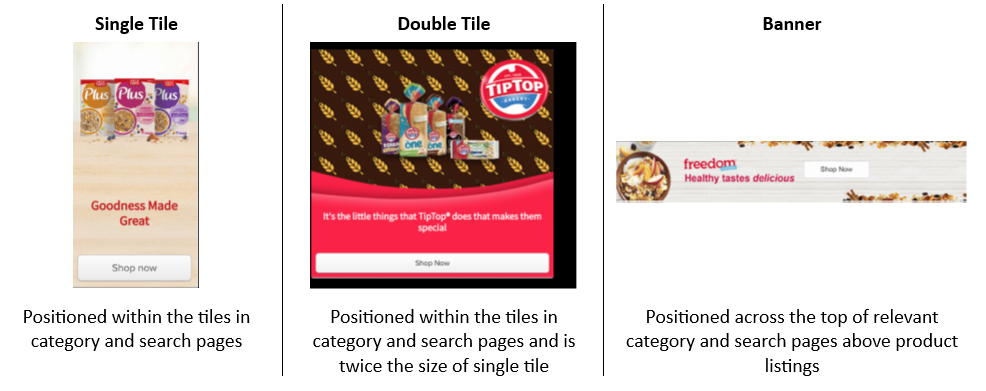
Banner campaigns can be deployed in the following formats:
* Single tile
* Double tile
* Full banner
## Implement banner ads
To set up banner campaigns, follow these steps:
### Step 1: Review the retailer's content standards
Content standards are guidelines and technical parameters that dictate how a banner ad should be displayed within a designated space on a website or digital platform. These standards may include:
* **Dimensions and size**: Specifications on the exact width and height of the banner.
* **File format**: Accepted image or video file formats, such as JPEG, PNG, or GIF.
* **File size limit**: Maximum allowable file size to ensure quick loading times and optimal performance on the webpage.
* **Resolution and quality**: Minimum resolution requirements to ensure the banner looks crisp and professional.
* **Positioning and alignment**: Guidelines on how the banner should be aligned within the available space.
* **Content restrictions**: Rules on what content can or cannot be included within the banner (e.g., no offensive content, inclusion of mandatory legal disclaimers).
Familiarize yourself with the retailer’s content standards guidelines to start your campaign. These guidelines include example URLs, page positioning, and specific artwork content restrictions. Consult your Customer Integration Engineer (CIE) for detailed information about available banner slots and their specifications.
### Step 2: Prepare creative assets
Develop your creative assets according to the retailer's content standards.
### Step 3: Identify the ad slot format
Determine the ad slot format for your deployment, which could be a full banner, single tile, or double tile.
### Step 4: Upload the creative assets
After creating your creative assets and identifying the ad slot format, upload them using the [Upload the creative asset](/retail-media-interface/partner/team-user-api/user-1/uploadfile-1.md) API. The API returns the file ID and URL of the image uploaded.
* **File IDs**: The file IDs are required when creating a banner campaign. You must provide a specific file ID for each asset type, such as the primary background, secondary background, hero image, and secondary hero image.
* **URL**: The URL is primarily used to preview the uploaded image.
### (Optional) Step 5: Retrieve the public URL of the image
Use the [retrieve file URL API](/retail-media-interface/partner/campaign-management-api/creativeassets/getcampaignfileurl.md) to obtain the public URL of the image. You can use this URL to verify or share the image with stakeholders.
### Step 6: Create a banner campaign
Create a banner campaign using the [Create a banner campaign](/retail-media-interface/partner/campaign-management-api/bannercampaign/createbannercampaign-1.md) API. Ensure you have the `artworkImageId` (`FileId`) that you retrieved using the [Upload the creative asset](/retail-media-interface/partner/team-user-api/user-1/uploadfile-1.md) API.
---
# Agent Instructions
This documentation is published with GitBook. GitBook is the documentation platform designed so that both humans and AI agents can read, navigate, and reason over technical content effectively. Learn more at gitbook.com.
## Querying This Documentation
If you need additional information that is not directly available in this page, you can query the documentation by asking a question.
Perform an HTTP GET request on the following URL with the `ask` and `goal` query parameters:
```
GET https://help.citrusad.com/retail-media-interface/partner/campaign-management-api/bannercampaign.md?ask=&goal=
```
`ask` is the immediate question: it should be specific, self-contained, and written in natural language.
`goal` is what the user is ultimately trying to achieve, the reason they need the answer. Sharing it helps GitBook give you a better, more relevant answer. A goal is most helpful when it describes the outcome the user wants rather than restating the question. For example, with `ask=how do I create an API token`, a goal like `automate deployments from our CI pipeline` lets GitBook tailor the answer to that use case.
The response will contain a direct answer to the question and relevant excerpts and sources from the documentation.
Use this mechanism when the answer is not explicitly present in the current page, you need clarification or additional context, or you want to retrieve related documentation sections.